
/ news / Storage Unit Sizes in Australia: What Actually Fits in Each One
Storage Unit Sizes in Australia: What Actually Fits in Each One
storage tipsPublished on November 18, 2026
Storage unit sizes in Australia are sold in square metres and given names like “walk-in robe” or “half garage”, and neither tells you much on its own. This guide translates the sizes into what they hold: how many boxes, which household they suit, and what a car needs. It also sets out the simple method for picking a size without paying for empty floor.
What storage unit sizes are there in Australia?
Australian storage units are measured in square metres of floor area and run from lockers under 2 m² up to garage-sized bays of 30 m² or more. There is no national standard, so dimensions vary between operators, but most ranges step through the same brackets: locker, small, medium, large, extra-large and garage-plus.
The independent comparison service StoragePrices.au groups the Australian market into seven brackets. Alongside them is how StorageX names its own units, taken from the live size guide, so you can see how the names map to the numbers:
| Market bracket | Floor area | StorageX unit names in this range |
|---|---|---|
| Locker | Under 2 m² | Walk-in robe (from 1.9 m²) |
| Small | 2–5 m² | Walk-in robe, large walk-in robe, XL walk-in robe (up to 4.8 m²) |
| Medium | 5–10 m² | ¼ garage (5–6.9 m²), ⅓ garage (7.5 m²), ½ garage (8.1–10.8 m²) |
| Large | 10–20 m² | ¾ garage (12–14.9 m²), garage (from 15 m²) |
| Extra-large | 20–36 m² | Garage (up to 27 m²), XL garage (21.4–29 m²), double garage (32 m²) |
| Garage-plus | 36 m² and over | Not offered |
| Vehicle | Priced per vehicle | Ask the facility |
Two things in that table catch people out. A “garage” at one operator can be 15 m² and at another 27 m², so compare floor areas rather than names. And the same name can sit on the ground floor or the first floor, which changes how you load it: StorageX lists both, with lift access on the upper floor and trolleys on the ground floor.
One more trap: a unit advertised as “5×10” by some Australian operators means 5 feet by 10 feet, roughly 4.6 m², not 5 metres by 10 metres. If a listing has no m² figure, ask for one.
What size storage unit do you need for a 1, 2 or 3 bedroom home?
A studio or one-bedroom home usually fits a medium unit of 5–10 m². A two-bedroom home needs a large unit of 10–20 m². A three-bedroom home sits at the top of the large bracket or into extra-large, 15–25 m², depending on how much furniture you keep and how tightly you pack.
Those ranges come from StoragePrices.au’s tracking of Australian units, and they line up with how StorageX describes its own: the ¼ garage is listed as “ideal for 1 bedroom unit worth of furniture”, and the ¾ garage as “great for large furniture and 2–3 bedroom home”.
| Household | Typical floor area | What that looks like |
|---|---|---|
| A few boxes, seasonal gear, one piece of furniture | 2–5 m² | Walk-in robe. You step in, you don’t walk around |
| Studio or 1 bedroom | 5–10 m² | ¼ to ½ garage. Bed, sofa, small table, 30–50 boxes |
| 2 bedrooms | 10–15 m² | ¾ garage. Two bedrooms of furniture, fridge and washing machine, 40–60 boxes |
| 3 bedrooms | 15–25 m² | Garage. Full household including whitegoods and outdoor furniture |
| 4 bedrooms or a house plus shed | 25–32 m² | XL or double garage |
The variable that moves you between rows is not the number of bedrooms, it is what you own. A two-bedroom apartment with a sofa bed and no dining table can go into a ½ garage. A two-bedroom house with a piano, a garage of tools and a trampoline cannot. Count the big items before you count the rooms.
If you are between homes and the storage is only for a few weeks, size for the tightest practical pack, because you will not be visiting. If it is for a year or more, go one step up so you can reach things. That trade-off is the same one covered in the moving house checklist.
What is the most common storage unit size?
The medium unit of 5–10 m² is the most popular size in Australia, according to StoragePrices.au’s market tracking. It holds the contents of a studio or one-bedroom apartment, it is large enough to stand inside and organise, and it is the size most households renovating a kitchen or living room end up in.
At StorageX that bracket is the ¼, ⅓ and ½ garage, and it is where the sizing decision usually gets made: small enough that the price difference from the next size up matters, large enough that running out of room is a real risk. If you are genuinely torn between a small and a medium unit, the medium is the safer error, because you can reorganise a half-empty unit but you cannot stretch a full one.
The other reason this size is common is that it is the one people underestimate their way into. Boxes are the usual culprit. Most people pack more boxes than they expect, and boxes take floor space unless they are stacked properly.
How many boxes fit in a storage unit?
Using a standard 40 × 40 × 60 cm moving box, a locker holds roughly 5–10 boxes, a small unit 15–25, a medium unit 30–50 when stacked to the ceiling, and a large unit 50–80. Those figures assume uniform boxes stacked in columns, which is the only way to get close to them.
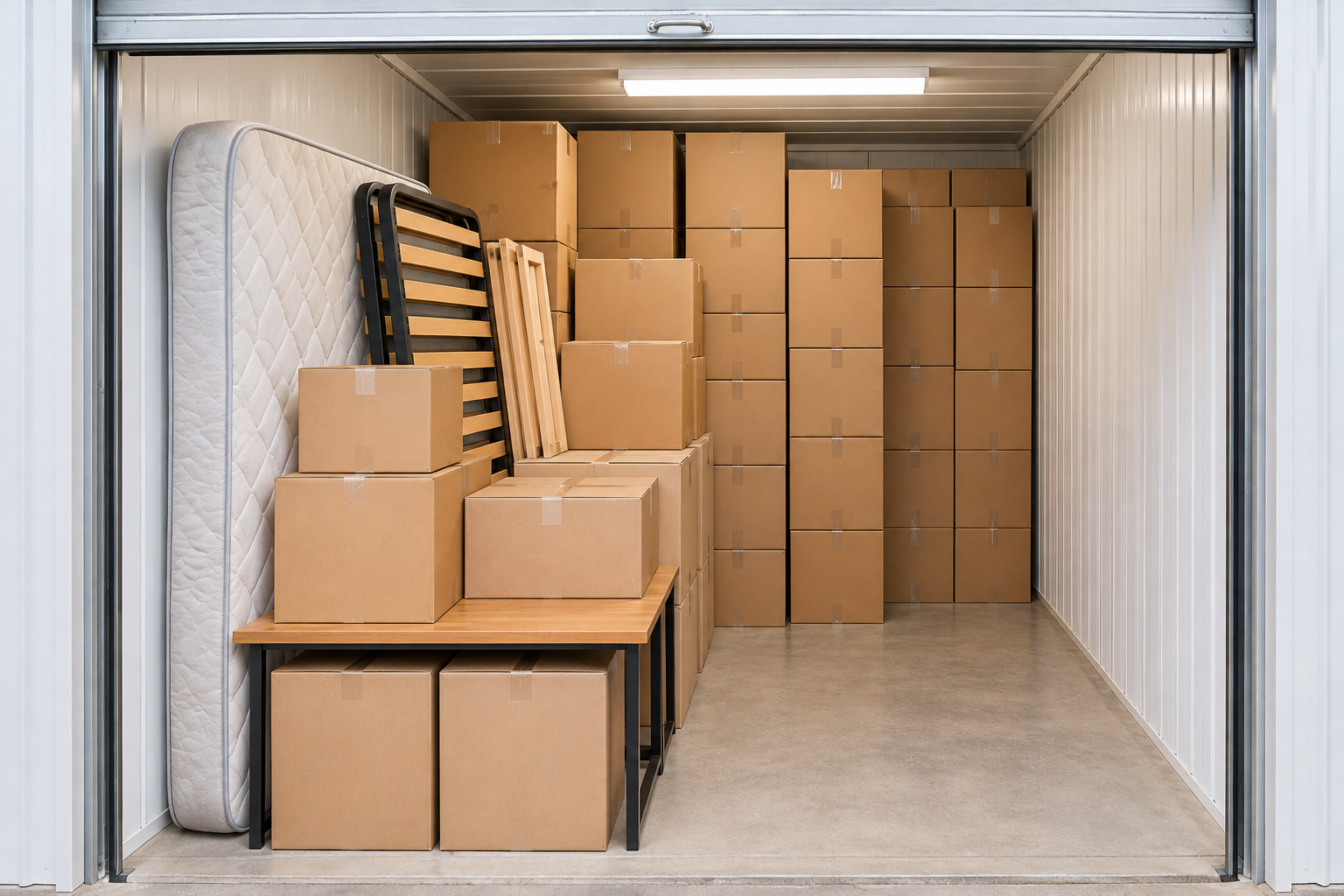
The counts come from StoragePrices.au and they are a ceiling, not a plan. In practice three things eat into them:
- Mixed box sizes. A stack of different-sized cartons leans, so you stop stacking lower than the ceiling. Uniform boxes from a box shop stack higher and safer than a mix of supermarket cartons.
- Furniture in the way. Every sofa or mattress on the floor is floor the boxes cannot use. Stand mattresses on their long edge, disassemble bed frames and tables, and stack boxes on top of flat furniture.
- An aisle. If you will need to get to the back of the unit during the term, leave a walkway. StoragePrices.au puts the cost of that at 20–30% of usable area, which is often the difference between one size and the next.
How you pack matters as much as what you pack. The site’s guide to packing a unit efficiently covers the order of loading, which is what decides whether the box counts above are realistic.
What size storage unit do you need for a car?
A car needs a unit longer than the vehicle with room to open a door and walk past, which in practice means a floor at least 5.5 metres long and around 3 metres wide. A standard Australian parking space is 5.4 metres long and 2.4 to 2.6 metres wide under Standards Australia guidelines, and that is a minimum.
The length is what rules sizes out. A 15 m² “garage” unit that measures 3 × 5 m is too short for most sedans once you allow for the roller door, and some mainstream utes are now over five metres long before you add a towbar. Measure the car, add at least half a metre, and compare that to the unit’s internal length rather than its area.
Two other things to check before assuming a garage-sized unit will take a vehicle:
- Whether the facility accepts vehicles in units at all. Some operators store vehicles only in dedicated spaces, open hardstand or under cover rather than inside a standard unit, and each is priced differently. Ask directly.
- What the facility requires of the vehicle. Registration, insurance, fuel level and a drip tray are common conditions. Get them in writing before you book.
If you are storing a car and household goods together, StoragePrices.au notes that one large or extra-large unit is often cheaper than a vehicle space plus a separate unit, provided the facility allows it.
How do you work out what size you actually need?
List everything you are storing, identify the single largest item, estimate the number of boxes, then decide whether you need to walk in during the term. Match the largest item to the unit’s internal dimensions first, because a sofa that will not fit through the door makes the floor area irrelevant.
Working through it in order:
- Write the list. Room by room. People who skip this step pick a size by feel, and feel runs small.
- Measure the biggest thing. Usually a sofa, a mattress or a dining table. Check it against the unit’s internal length, width and door opening, and ask about ceiling height if you plan to stand anything on end.
- Count the boxes. Then round up. Use the box counts above to find the bracket.
- Decide on access. No visits planned: pack tight and size down. Regular visits: add an aisle and size up.
- Check the floor. Ground floor with drive-through or trolley access is faster to load. First floor with a lift is fine for boxes and manageable for furniture, but allow more time on moving day.
- Get the m² figure in writing. Not the name. Then compare like with like.
Once you have the bracket, StorageX’s size guide lists every unit by floor area, dimensions and floor, which gets you to a quote for the exact space rather than a category. Prices follow the size, so it is worth reading how storage pricing works in Melbourne before you compare quotes, because an introductory rate on the wrong size is still the wrong size.
StorageX unit sizes at a glance
StorageX units run from a walk-in robe to a double garage across the Huntingdale and Northcote facilities, on both the ground and first floors. The names and floor areas below are taken from the live size guide and are the ones you will see when you book personal storage.
| StorageX unit | Floor area | Floor options | What it suits |
|---|---|---|---|
| Walk-in robe | 1.9–2.6 m² | Ground, first | Studio apartment, small business, or decluttering a home |
| Large walk-in robe | 3–4.4 m² | First | As above, with room for a piece of furniture |
| XL walk-in robe | 4.5–4.8 m² | Ground, first | As above |
| ¼ garage | 5–6.9 m² | Ground, first | One-bedroom unit’s worth of furniture and some boxes |
| ⅓ garage | 7.5 m² | Ground | Between a one and two bedroom load |
| ½ garage | 8.1–10.8 m² | Ground, first | Two bedrooms packed tightly |
| ¾ garage | 12–14.9 m² | Ground, first | Large furniture and a 2–3 bedroom home |
| Garage | 15–27 m² | Ground, first | Full household |
| XL garage | 21.4–29 m² | Ground | Large household or business stock |
| Double garage | 32 m² | Ground | House plus shed, or business |
Dimensions differ within each name. StorageX’s ½ garages, for example, run from 2.9 × 3 m to 4 × 3 m and 3.5 × 2.5 m, so if your largest item is long, ask for the longer one.
Before you book
Pick the size from the list of what you own, not from the number of bedrooms, and compare units on square metres rather than names. If you are between two sizes, the larger one is the cheaper mistake. And if you have measured and are still unsure, the office can look at your list and tell you which unit it fits in, which takes five minutes and saves a month’s rent on the wrong size.
Get to know strorage like we do
You Can Also Read
Discover the ultimate solution for your storage needs
Premium Storage
Discover the ultimate solution for your storage needs with our premier self storage units in Melbourne. Our services offer unparalleled convenience and security, ensuring your belongings are kept safe and accessible whenever you need them.
